
DPH Logo

Exploring Food Insecurity in SC Exploring Food Insecurity in South Carolina

Food insecurity touches every corner of South Carolina — but it doesn’t look the same everywhere. In some communities, grocery stores are miles away. In others, unhealthy food options drown out nutritious opportunities. And in many places, fresh produce is available — but priced beyond what many individuals and families can afford.
These are the realities of food deserts (areas where access to grocery stores is limited ) food swamps (areas overly saturated by unhealthy foods), and food mirages (areas where it appears there is an abundance of healthy food options, but are inaccessible due to price or cultural restrictions). These three food environments are the faces of a growing health crisis hiding in plain sight.

Food security is based on four main pillars:

  1. Availability : there is enough food produced and supplied to meet people's needs.
  2. Access : everyone can get food, both physically and financially.
  3. Utilization : making sure food is nutritious, safe, and used in a healthy way.
  4. Stability : these three pillars — availability, access, and utilization — remain steady over time, even during challenges like economic downturns, conflicts, or natural disasters.1

An earlier definition of food security stated:

“Food security exists when all people, at all times, have physical, social and economic access to sufficient, safe and nutritious food which meets their dietary needs and food preferences for an active and healthy life”.1
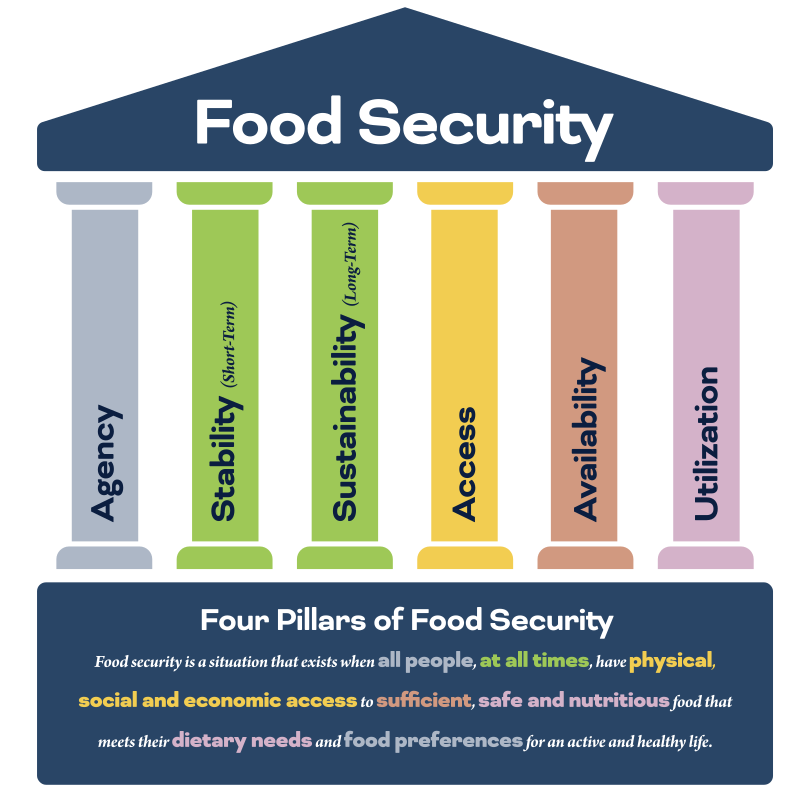
In 2020, these pillars were expanded to include sustainability and agency — establishing the six dimensions of food security. Sustainability refers to maintaining adequacy in supply of foods overtime, including being maintained during sudden, short-term shocks and cyclical or seasonal changes. Agency is the power to make decisions about foods eaten and produced, including making choices about what foods are eaten, produced, and processed.2 These additions were made to strengthen and broaden the understanding of food security.1

Feeling Insecure

When one or more of these pillars are not met, food insecurity is created. South Carolina has the seventh highest rate of food insecurity in the US, with 14.4% of South Carolina households being food insecure.3 Allendale County saw the highest rate of food insecurity in 2023 at 20.2%, which was an increase from the previous year, 16.8%.
Use the map to see the food insecurity rate throughout South Carolina from 2023.

When people think about food insecurity, typically, their first thought is food deserts. However, food deserts are only one type of food environment linked to food insecurity. Two other emerging food environments are food swamps and food mirages.

How Do They Differ?

Critical Limitations

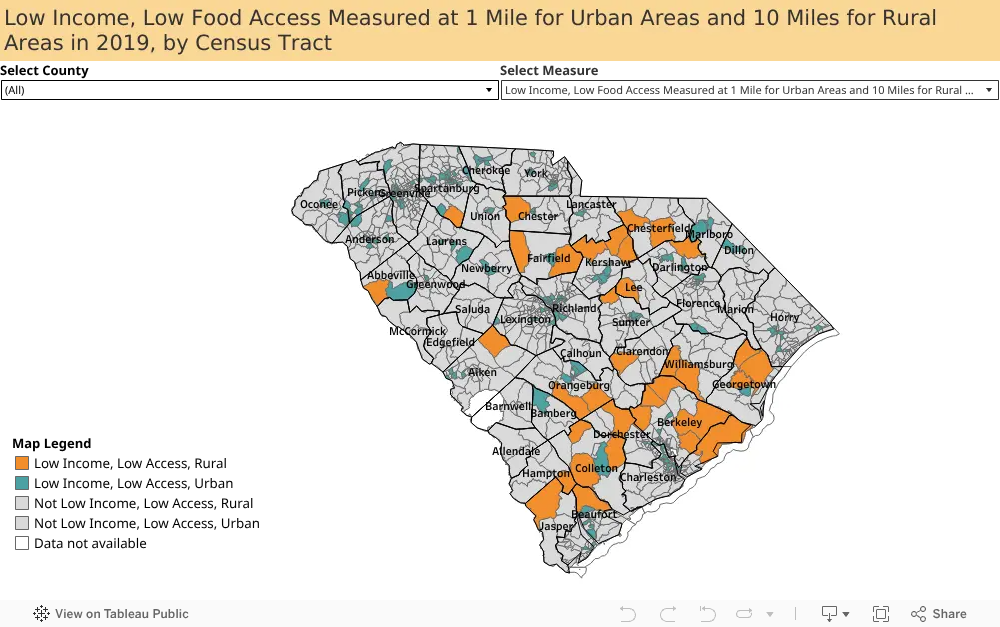
Food deserts are defined by the U.S. Department of Agriculture (USDA) as an area where at least:

  • 20% of residents live below the poverty line, and
  • 33% of the residents live more than 10 miles (in rural areas) and a half mile (in urban areas) from the nearest grocery store.4

According to the USDA, 40 out of South Carolina’s 46 counties had at least one census tract designated as a food desert.

Use the map to explore the number of food deserts by census tract in South Carolina for 2019 .

Oversaturated

Food swamps are defined as communities having an oversaturation of unhealthy food choices such as fast-food restaurants relative to healthier options.5 This oversaturation and lack of physical accessibility make it difficult for residents to make nutritious food choices.

Between 2011-2016, Marion County experienced the largest percentage increase in fast-food restaurants in South Carolina, with a growth rate of 46.7%.

Use the map to see the percent change of fast-food restaurants across South Carolina from 2011-2016.

Illusion of Choice

Unlike food deserts and food swamps, food mirages are areas where healthy food options are available – but not necessarily accessible. Specifically, despite the physical availability of food, the food may be too expensive or not culturally appropriate for the local population.6
This physical availability of food creates the illusion of abundance. But if people can’t afford it or it doesn’t meet their cultural or dietary needs, that availability becomes insufficient.
In 2023, Charleston County had the highest average cost per meal in South Carolina at $4.15, compared to the statewide average of $3.41.
The graph shows the average cost per meal in counties across South Carolina in 2023.

The Connection between Food Insecurity and Health

Food insecurity can increase a person’s risk for negative health outcomes and is closely linked to a higher risk of chronic health conditions. People facing food insecurity are more likely to experience Type 2 diabetes, heart disease, high blood pressure, and obesity.7

In South Carolina, the percentage of adults who are obese has consistently remained above 30% for the past decade (2013-2022), according to the Behavioral Risk Factor Surveillance System (BRFSS). Similarly, the proportion of adults with high cholesterol has also stayed above 35%, according to the BRFSS. Diabetes is also a major health issue for South Carolinians with an overall prevalence of 13.3% from 2018-2022. McCormick County had the highest diabetes prevalence at 24.3%.

Use the graph to explore the prevalence of chronic disease and diabetes mortality in South Carolina.

Addressing Barriers

Food insecurity in South Carolina is shaped by several key barriers such as busy schedules, financial constraints, and geographic access.

Many people struggle to find time for grocery shopping and cooking because of demanding work lives. Cost is another major hurdle. In the 2023 Community Health Needs Assessment, when asked “What prevents the members of your community from eating healthy?” the most frequent response was “it is too expensive.”

Use the map to explore the top reasons communities in South Carolina listed for not eating healthy based on the 2023 Community Health Needs Assessment.

Place matters

Where people live also matters. Both rural and urban areas often lack easy access to fresh food. As previously mentioned, cost can present a substantial barrier to accessing healthy food. Access to reliable transportation can also make it harder for people already struggling to afford the cost of food.
Without reliable transportation, people can struggle to access the nearest supermarket. In rural communities, the distance can be extreme, measuring up to 20 miles.8 For urban communities, the distance may not be the issue, but having access to dependable transportation can still pose a barrier. If public transportation is available, the schedule may conflict with their schedule, the wait times may be too long, or the public transportation fees could exceed their budget. For those who own vehicles in both rural and urban settings, traffic congestion or car maintenance cost can impact the choices of where they shop and what they buy.9
Addressing food insecurity requires flexible, community-specific solutions that fit the unique needs of each community.
Use the map to explore low income, low access rural and urban communities throughout South Carolina in 2019.

Assisting Our Communities

Challenges to food security is a long-standing issue in the U.S. In 1939, the first food stamp program was launched to help residents manage food costs. The program has gone through several legislative changes and updates and is currently called SNAP – the Supplemental Nutrition and Assistance Program.10
In 1972, an amendment to the Child Nutrition Act of 1966 established a new program for low-income pregnant women and children. In 1973, the program was renamed the Special Supplemental Food Program for Women, Infants, and Children (WIC). Originally meant to last two years, WIC became permanent in 197511
Despite the availability of these programs, underutilization remains a challenge in South Carolina.

  • In 2021, the USDA estimated approximately 23% of SNAP-eligible residents were not enrolled.12
  • Similarly with WIC, in 2022, America’s Health Rankings reported a low participation rate for children aged 1 to 4 years old.13

Use the map to explore the percent change in participation rates of SNAP benefits and WIC benefits in South Carolina.

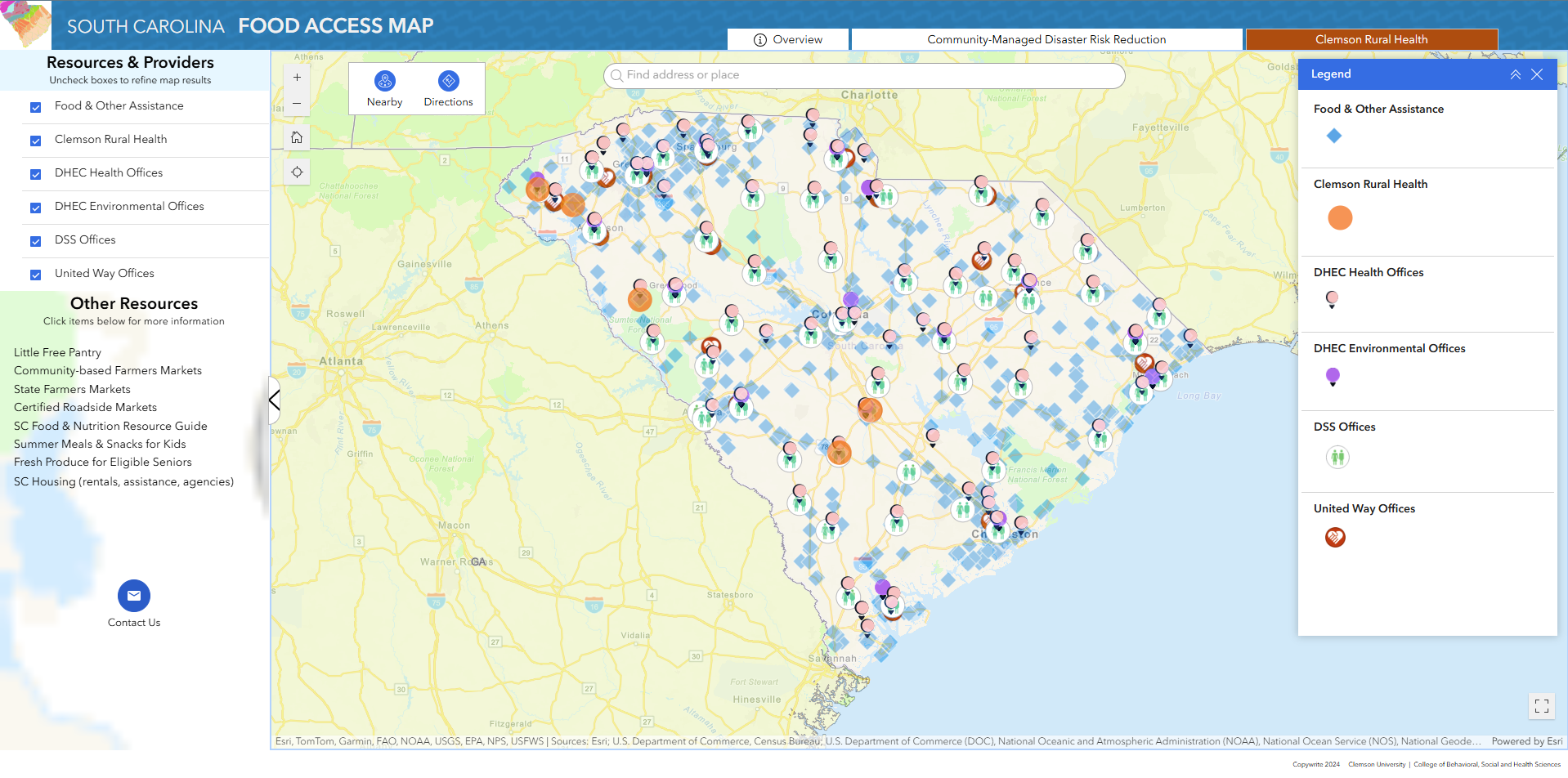
SNAP and WIC are not the only available resources for food assistance in South Carolina. Throughout the state there are food banks and food share programs. Harvest Hope Food Bank, Lowcountry Food Bank, and Feeding the Carolinas are a few organizations committed to helping address food insecurity throughout South Carolina. These organizations played an important role during and after COVID-19. In 2023, some organizations struggled to keep up with the community need. However, despite the challenges the missions of food banks in South Carolina have not changed.14 In partnership with the South Carolina Department of Environmental Services, Clemson University College of Behavioral, Social and Health Sciences, Ten at the Top, and United Way of Pickens County an interactive map was developed to provide geographical information about food resources in South Carolina. This map allows residents to find reliable information about food resources in South Carolina and reduce the challenges associated with accessing healthy, affordable food.15
To explore the South Carolina Food Access Map, click here.

How can we reduce food insecurity in South Carolina?

The Food Access Dashboard is a powerful tool for understanding and addressing food insecurity in South Carolina.

By exploring the data, people and organizations can identify the specific challenges their communities face—whether it’s high food costs, low program participation, or limited access to healthy food. Strengthening food assistance programs, encouraging enrollment among eligible residents, and addressing food costs are just a few ways to help address food insecurity in South Carolina.16

On a local level, this information can support meaningful action. For example, sharing insights with community members during town halls, community events, or religious functions can help target your communities’ needs and challenges.

When thinking about addressing food insecurity in your community it is important to determine what type of food environment you are living in. Not all food environments have the same barriers – and the reasons people struggle to eat healthy can vary. It’s important to use data to identify the roots of the problem to develop a viable solution. Identifying the root causes of food insecurity is the first step toward creating practical, data-informed, community-driven solutions.

Ask yourself:

  • What type of food environment do I live in?
  • Is it a desert, a swamp, or a mirage?

References